
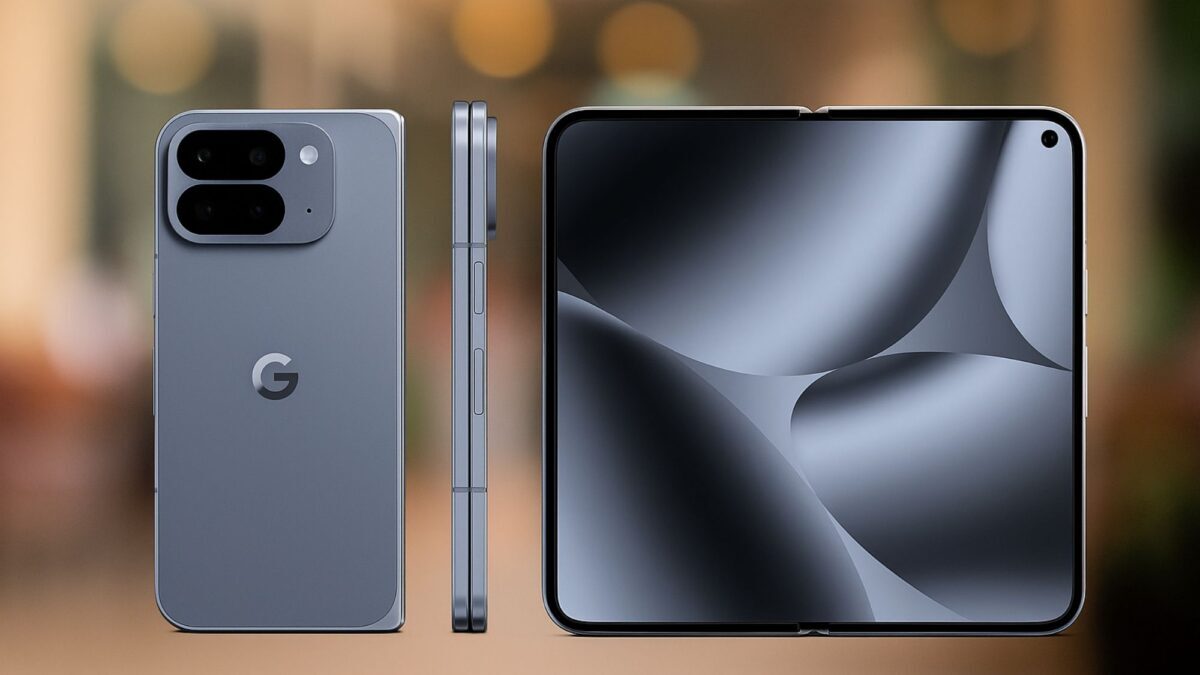
The Pixel 10 Pro Fold is the perfect combination of a tablet and a smartphone, made possible by Google’s cutting-edge AI and camera innovations. Though the Pixel 10 Pro Fold shares the same space as the Samsung Galaxy Z Fold 7, their strategies are like night and day. Unlike Samsung, which emphasizes the lighter and thinner side of the device, Google has chosen to make a “tankier” device that ensures the user’s safety and hence the user’s peace of mind.
Design & display With Ultimate Protection
The design of the Pixel 10 Pro Fold is most reflective of the major conceptual change Google made when it decided to keep the device, in general, the same shape as the prior model. Its dimensions when shut are 10.8 mm, and it weighs 258 grams; thus, it is quite a bit thicker and heavier than the super-light Samsung Galaxy Z Fold 7, which measures a mere 8.9 mm when closed and weighs only 215 grams.
Besides explaining the addition of weight with a fight, Google tries to convince us of the unprecedentedly long durability of the Pixel foldable device. The Pixel 10 Pro Fold comes with an IP68 rating with respect to water and dust resistance. To the best of our knowledge, this is the first time such a rating has been given to a large horizontal foldable.
With the Pixel 10, Google has gone a step further in terms of build quality by choosing Corning Gorilla Glass Victus 2 for the phone and the cover screen, while its frame is made of aerospace-grade aluminum. In a way, the Z Fold 7 gives off a nicer and more stylish look than this device, yet one cannot deny the fact that the quality of the build is pretty good, and hence, the device has got a premium as well as a utilitarian feel to it.
Dual Displays: A Window and a Canvas
The Pixel 10 Pro Fold display plays the trick to impress whoever sees it folded or unfolded. It consists of two extremely bright and very high-quality OLED displays.
The cover display is a 6.4-inch OLED panel with a very comfortable aspect ratio, and thus, the device feels more like a traditional single-user smartphone, i.e., natural, than the weirdly wide ones, which was the case before. It can reach a maximum brightness of 3,000 nits; that is why, even under direct sunlight, good visibility is guaranteed outdoors.
The incredible 8.0-inch inner Super Actua Flex Display essentially changes the phone to a real mini-tablet upon the phone being unfolded. This screen also can reach the very bright value of 3,000 nits at its peak and has an adaptive 120 Hz refresh rate. Besides being ultra-thin, the glass is further strengthened with an additional layer.
One area where the Pixel Fold could still work on is the display crease. While the crease is there but still functional, reviewers acknowledge that the fold line is more apparent than the almost-flat panel on the latest Galaxy Z Fold, which means that Google has made an aesthetic trade-off for a more durable, IP68-sealed hinge.
Performance, Power, and Battery Life
Google’s new Tensor G5 chipset is the heart of the Pixel 10 Pro Fold. This chip is custom-built to enhance the device’s performance in AI and machine learning tasks. However, some reviewers point out that the phone lags behind the Galaxy Z Fold 7 equipped with the latest Snapdragon chip in pure synthetic benchmarks and heavy gaming, despite the fact that the G5 provides a significant generational leap in AI capability.
Still, the Tensor G5 is the right choice for a new generation of local AI features. Moreover, the phone’s standard memory is an enormous 16GB of LPDDR5X RAM, which guarantees that multitasking on its large folding screen will be smooth. The storage space varies from 256GB to 1TB.
Google’s major win is the battery life. The Pixel 10 Pro Fold is equipped with a large 5,015 mAh cell, which is a significant amount of fresh air compared to its rival’s 4,400 mAh. In internet tests, the Pixel is almost always two hours ahead of the Galaxy Z Fold 7; thus, it can easily be regarded as a heavy-use device for a whole day.
The phone is compatible with a maximum of 30W wired charging and decorated with the new 15W Qi2 wireless charging with PixelSnap. This magnetic charging ability is a big quality-of-life improvement; thus, it is compatible with the quickly expanding universe of magnetic accessory devices such as charging stands and car mounts, which is the first ever for an Android foldable.
The AI and Software Experience
Pixel 10 Pro Fold’s software is Google’s play to be different from the others. The phone that runs on Android 16 is the recipient of seven years of updates to the OS and security, without a doubt. Such a long-term commitment is a great proposition and is the main reason why a foldable phone with so many features can stay relevant for almost 10 years.
One of the main installation features of the user interface is Google’s AI Gemini models.
- Gemini Live: The on-demand AI assistant may be spoken to in live conversations, visually on your display, or via the camera. As it is a modally multi-helper, it facilitates far-reaching tasks executed over several apps interactively.
- Magic Cue: With this feature, a great deal of quick and highly pertinent information can be fetched by simply utilizing the stored data in your Google apps—thus, it becomes a very efficient local-data-based on-device search and info retrieval tool.
- Camera Coach: This intelligent helper captures the environment and suggests to the user the best framing, the necessary lighting, and the ideal composition to get a better shot in real time.
While a few dissenting voices bemoan the fact that the AI has not been utilized more thoroughly to change the game fundamentally, it is still felt that the Fold also misses out on a multitude of exclusive, killer feature points that are directly related to the unique folding form factor—a feature gap Google must close to fully justify the device’s “Pro Fold” moniker.
Camera: Good, But Not “Pro”
Usually a major part of the story that sells the Pixels is the camera.
The Pixel 10 Pro Fold is equipped with a three-camera system at the back:
- 48MP Wide-Angle
- 10.5MP Ultra-Wide
- 10.8MP Telephoto with 5x optical zoom
The photos turned out to be detailed and vibrant, and thanks to Google’s renowned image processing, the photos come out top-notch, but the photographic unit is the most substantial compromise of the handset. The sensors are a downgrade compared to the main Pixel 10 Pro model, which has a higher-resolution main sensor and the amazing 100x Pro Res Zoom capability.
The Pixel 10 Pro Fold only supports a 20x Super Res Zoom. Reviewers, in their side-by-side comparisons with the standard Pixel 10 Pro, noted that the Fold camera’s photos occasionally struggled in difficult lighting conditions, and therefore, the color was less accurate, and there was more noise.
The Google Pixel 10 Pro Fold represents a bold and mature move toward the foldable future. Instead of thinning the device, Google’s choice to feature an IP68 rating, a large battery, and its state-of-the-art Tensor G5 AI is a strategic decision that directly tackles the issues that have been preventing a lot of people from buying foldable devices: their durability over time and the fear of running out of battery.
While the camera system is noticeably inferior to that of the flagship Pixel 10 Pro, the overall package—from the incredibly bright displays to the seven years of software support—makes the Pixel 10 Pro Fold a very attractive device. It is an excellent option for the user who wants a robust, feature-rich, AI-powered foldable tablet that is really made to last.
The competition of foldable phones is no longer about who can make the thinnest device, but rather about who can make the most practical and reliable one. In this aspect, Google has come out victorious.